

This is an attempt to summarize what D.C. United is doing tactically right now, in the hope that it will facilitate productive discussion as the season gets underway. The obvious disclaimers apply: I'm not a mind reader, I don't have any special access to DCU management, some of the below is just my opinion, and all of it is informed in part by the thoughts of other B&RU staff and commenters.
Also, for purposes of this piece, I am going to treat Chris Rolfe as a super-utility attacker rather than a starting XI guy, which means his name won't come up too much. This has nothing to do with his quality and everything to do with the fact that he can adequately fill any of the attacking roles we have, and so does not limit our tactical options.
With that said... on the evidence of the preseason and the CCL games, it looks to me like Dave Kasper and Ben Olsen have a particular shape and style in mind, and that our offseason moves have been less a case of "we need to get useful guys" and more a case of "we want to achieve a specific effect on the field."
What is this "4-4-1-1" of which you speak?
Like most formation designations, it could be a lot of things. But for DCU, with this roster, it means "we're putting each individual player where they can make the greatest possible contribution, and we're terribly sorry but that doesn't fit easily in X-X-X nomenclature".
For the last few years, DC has continuously fought with how to fit Chris Pontius, Perry Kitchen, and Nick DeLeon into the same four man midfield, which is basically a squaring the circle problem... there is no good solution. Perry's limitations in the attack, Nick's tendency to be a complementary player rather than a driver, and Party Boy's need to attack from wide could only be properly accommodated in a 4-5-1, which in turn demanded a target forward of the sort we have never employed (EJ included).
With Kitchen gone, the team's style is defined by, and constrained by, four key factors:
1. We don't have a hold-up forward in the starting XI. Our primary finishers are Fabian Espindola, Chris Rolfe, and Lamar Neagle, and these are all guys who thrive on movement and misdirection, not physicality and stability.
2. The acquisition of Luciano Acosta and Julian Büscher means we have a lot invested in a pure playmaker role, an investment disguised only by the fact that they are both very young.
3. With DeLeon moving inside, the wide midfielders are an aggressive crowd. The particular skill set of Neagle, Patrick Nyarko, and Miguel Aguilar pushes us very strongly toward a certain style of play.
4. Benny won't play a straight diamond, for the very good and sufficient reason that even Kitchen wasn't up to being isolated while the other mids all went into the attack, let alone Marcelo Sarvas or Markus Halsti.
So, starting with the fact that Espindola is going to roam around regardless of where you nominally play him, and having decided to go the Acosta/Büscher route, the braintrust had to figure out how the team was going to produce goals from the run of play without a constant presence in the box. They chose to solve the problem with Lamar Neagle.
You can call the result a 4-4-1-1, or a 4-2-3-1, or a bucket 4-4-2 with free-role forwards, but the effect is the same regardless:
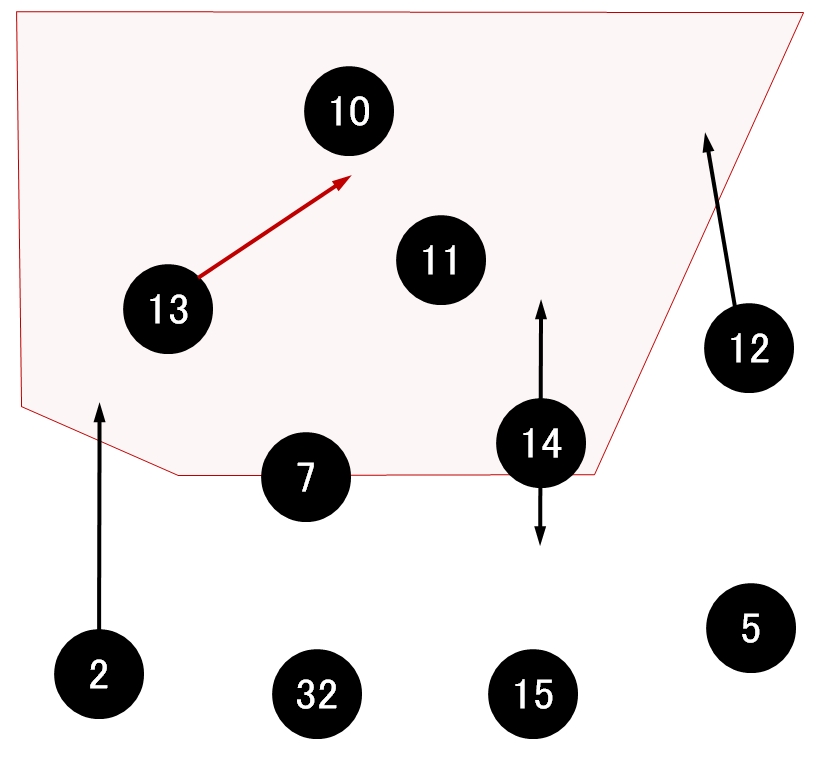
(The area in red is the range and native habitat of fabinius espindolensis, a highly migratory species with which I am sure you are all rather familiar.)
There are some very sophisticated things going on here, not all of which can be shown in a static diagram.
The attack is built around the threat of the inverted wing.
It's been so long since Pontius was Pontius, I think we've started to forget how powerful a weapon a good inverted winger can be. Neagle is a well-established commodity: a shoot-first guy who doesn't do well in tight spaces. In this system, we surround him with moving parts (Espy, Joe Taylor Kemp, Acosta, whichever CM is in the advanced role at the moment) who will drag defenders out of position, which gives Neagle the space he needs to attack the net with clear visibility and room to run.
This job is absolutely key, because it is the threat of his runs into the box that keeps center backs honest in the absence of a traditional center forward. I can't say this strongly enough: this particular formation, with these personnel, flatly will not work if defenses can just leave one center back in a sweeper role and let the other one go out and mark who he pleases. An opponent who has one CB spying on Acosta and the other pursuing Espindola into the corner must be punished by moving the ball to find a player attacking the box from deep. Once the opponent is forced to respect this threat, that in turn will leave Espindola (and, in many cases, Nyarko and/or Acosta also) in man coverage, which is very much to our advantage.*
Rolfe, Aguilar, DeLeon, and Rob Vincent should all be able to handle this job to varying degrees, but Neagle is tailor made for it.
The asymmetries play into the strengths of the new acquisitions.
As others have already noted on this board, we are likely to favor moving the ball up the left side. Espy likes to drift that way, Kemp gets forward a lot, and Neagle is a focal point of the attack. With proper movement and passing, this helps Neagle by creating seams for him to run into. Just as importantly, it also helps Nyarko (or Aguilar), because he will often be isolated with his marker on the right side. Getting opponents focused on the threat down our left and then quickly switching to Nyarko on the right should give him many opportunities to shine by doing what he does best, beating people off the dribble and exploiting the wide open pastures on the other side of the move.
The center midfield should see a vast improvement in productive possession.
Kitchen-Arnaud was an excellent airtight defensive midfield, but their combined ability to support the attack often left much to be desired. Kitchen was a very safe passer, in fact too safe, and only at the very end of his tenure here did he even begin show some vision on a regular basis. Arnaud's technique was quite poor, and when combined with his helter-skelter playing style, the result was a combination of bad giveaways and awkward spacing that repeatedly hamstrung us, reducing our effective options to playing up the sidelines or over the top.
Sarvas-DeLeon will not be as good defensively, but we can already see a huge improvement in spacing when DC has the ball. Where Kitchen-Arnaud made their first priority, "Who has the sweeper position covered?", Sarvas-DeLeon first ask, "Who has the central distribution/facilitation position covered?" I think we have seen the end of DCU going game after game after game without ever seeing two short passes travel through the center of the formation on their way to a scoring chance.
The above elements are set up to work even if the #10 isn't on the field.
If you're going to put a true playmaker in your tactical system, then the best way to proceed is to play with tactics that don't require the playmaker. This apparent paradox follows because classic #10s have the greatest impact when they are given the most freedom to do as they see fit, and the surest way to give them that freedom is to have an attack that doesn't technically require their services at all.
For Acosta and/or Büscher, this should all have a force multiplier effect, with everyone else's work creating weaknesses for them to exploit. When the defense has to worry about Espindola's roaming, Neagle's slashing, Nyarko's dribbling, Kemp's crossing, and Sarvas or DeLeon crashing in from deep, it's hard to also put enough resources into shutting down the guy we want to be the hub of the offense.
If neither Acosta or Büscher is available, then we can bring in Alvaro Saborio and revert to a standard 4-4-2. It won't be pretty, but it will be functional, and most of our players won't have to change their thinking beyond dropping a little deeper without the ball.
Will it actually work?
My biggest concern with this tactical arrangement is that it is not at all a simple plan to execute. It heavily depends on off-the-ball movement, tradeoff decisions between partnerships, and quick changes to the point of attack. In other words, teamwork. We're going to have a tough March and April, I think, where it will be impossible to tell the difference on the available evidence between
"This new midfield sucks! Bad positioning, lots of turnovers. #OlsenOut"
and
"This new midfield will be excellent once everybody learns to play together."
My greatest hope with this system is that it could be quite powerful if everything clicks. There are five positions** that can attack the box from any direction at any given moment, and thus many possibilities for drive-and-dish plays like you see in basketball.*** This isn't just for show, it's a strong solution to beating teams that have good defensive organization or who feel like they can park the bus.
Will it happen? Maybe not right away, and maybe never. I'm skeptical that DeLeon will be good enough in the center to support that part of the equation. Acosta and Büscher are both young and developing. Espindola runs hot and cold, and sometimes forgets that it's a team game. The tactical change should support more scoring, but I don't think I am the only DCU fan who is concerned that our defense may fall apart in the absence of both Kitchen and Bill Hamid. Benny leaned pretty hard on a very unusual model last year, and it won't work that way again. And the team still has the desire and capacity to make a DP-grade acquisition, which could drastically change everything.
But, for now, it's a plan. A pretty good one, actually. I'm looking forward to seeing it in action.
---
* Obviously, by "will not work" I do not mean "will produce zero goals." But without the outside threat from this position, given that Nyarko can't finish and Rolfe can't go 90 much anymore, goals will mostly have to come from individual acts of brilliance or unforced errors by the opposition. Just like last year's offense. :(
** Counting Nicky D, who may or may not actually be able to pull it off.
*** Player A drives to the basket, draws multiple defenders to his point of attack, kicks the ball back out to the perimeter. Player B then drives from a different angle, against a defense that is now already out of position. Properly done, Player B should have a knight's fork situation, where he presents four threats (continued drive to the basket, close-in pull-up jumper, penetration pass to the big man, kick it back out for an open 3) and the defense can cover at most three of them.